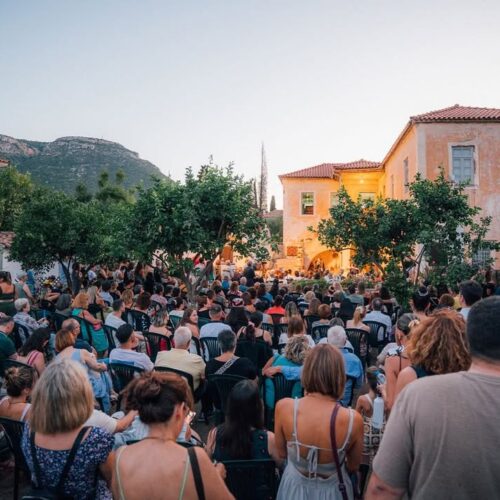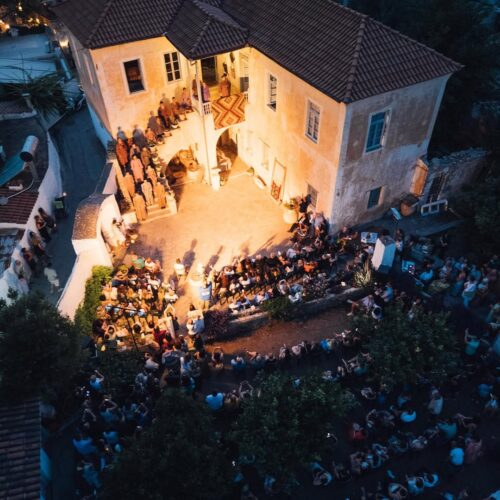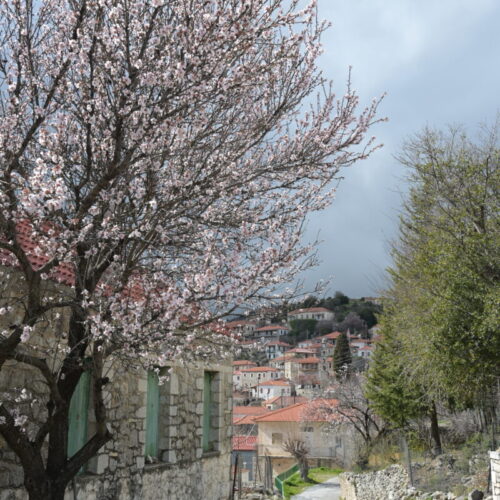


Paleochori is a mountain village in Southern Kynouria, built on the slopes of Mount Parnonas at an elevation of approximately 850 meters, near the border with Laconia. Its location within the mountainous landscape of the eastern Peloponnese, combined with its relative isolation and natural surroundings, shapes the character of this small but historically significant village in the region.
The historical topography of the settlement and the wider region is of particular interest. To the northwest of the village, in the direction of Agios Vasilios and Platanaki, the ruins of a medieval castle remain, as well as the now-ruined Monastery of Palaiopanagia. Pottery shards have been found at the same site, while a fragment of an ancient statue is visible at the entrance to the main church of the old monastery—evidence attesting to the long history of settlement and the enduring significance of the area from antiquity through to later periods.
In its modern administrative history, Paleochori has been officially mentioned as early as 1835, when it was incorporated into the municipality of Glypia. In 1856, it was designated the seat of the municipality of Glypia, a fact that underscores its importance in the local administrative structure, while in 1915 it was renamed Paleochorion of Glypia, a name that was corrected in 1940 to Paleochorion. Although today it is a small mountain village, Paleochori retains strong traces of its historical development and serves as a prime example of the connection between the natural landscape and the enduring human presence on Mount Parnonas.
Sofia Vogiatzi designed the seal for the community of Paleochori

Sofia Vogiatzi

Find the stamp at TAVERNA KARAVITIS
Please contact George Karavitis by calling 6972694661
Originally from Piraeus and now based in Cambridgeshire, United Kingdom, Sofia Vougiatzis is an illustrator and graphic designer specializing in both digital and fine art printing. Working with both analog and digital media, her practice explores themes such as everyday life, nostalgia, and cultural duality, while also reflecting on memory, the past, and the concept of the “good old days.”