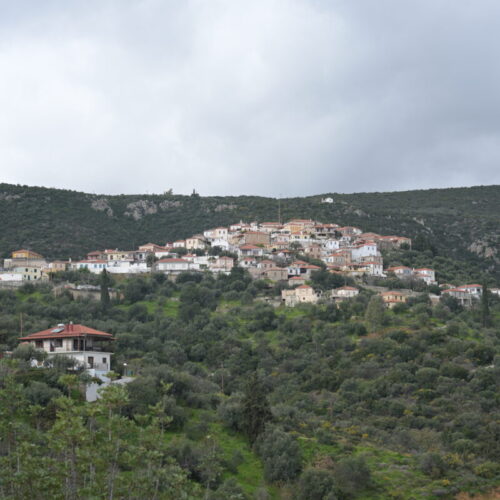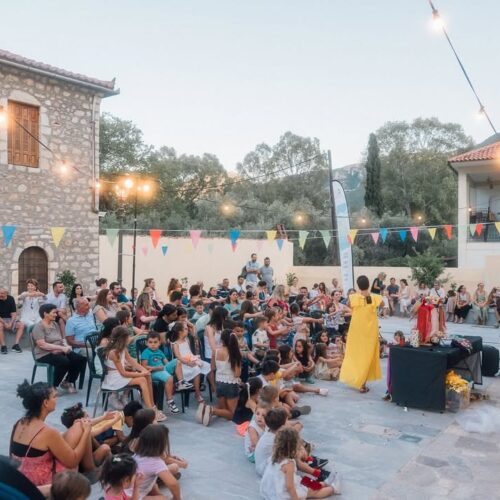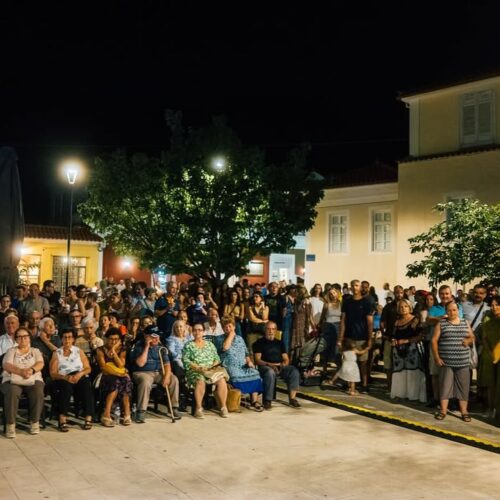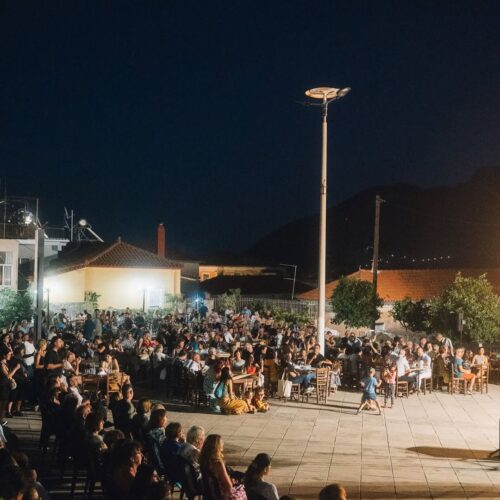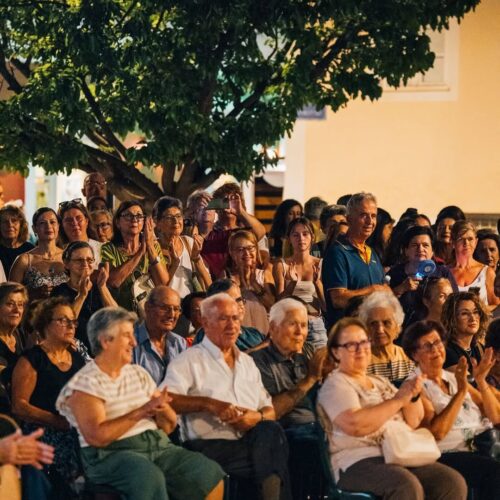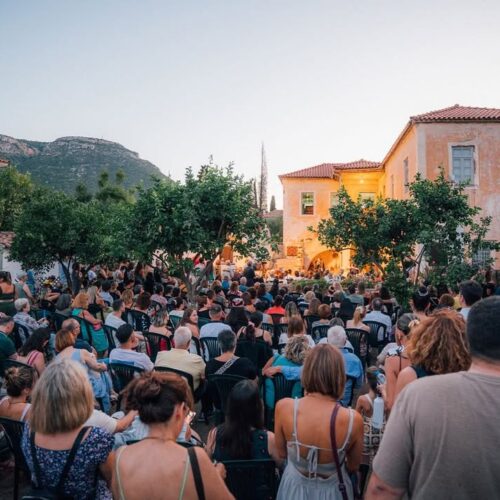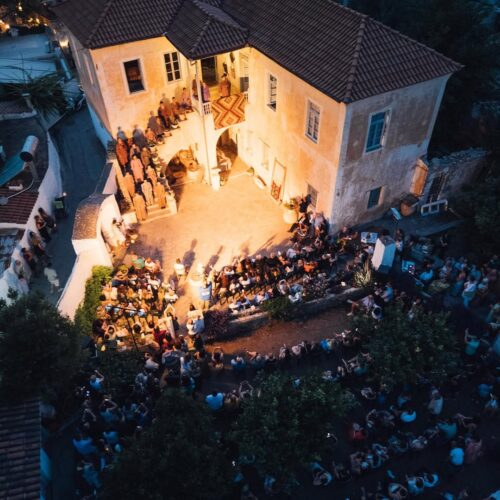

Pragmateutis(in the Tsakonian dialect: Pramateuta) [also known as Pragmateuti] is a village in Southern Kynouria, situated in a particularly privileged location between the mountains and the sea, and connected to the beaches of Sambatiki and Thiopafto. It is a village with a strong Tsakonian identity, which is evident in both the language and the local cultural traditions. The use of the Tsakonian dialect remains visible to this day in signs and in the daily lives of the residents, a feature that gives the village its distinctive character. Despite the decline in the permanent population—particularly following waves of emigration to the United States and, within Greece, to Athens and Piraeus—Pragmateftis comes alive during vacation and holiday seasons, maintaining strong ties with its people.
The history and name of the village are linked to trade, as the name Pragmateftis refers to a merchant—the primary occupation of the inhabitants in the past. The settlement is part of the broader historical and cultural landscape of Kynouria, a region that, despite its relative geographical isolation due to Mount Parnonas, maintained close ties with the rest of the Peloponnese. Pragmateftis is home to significant religious and local monuments, such as the Church of the Holy Trinity in the center of the village, the 18th-century Church of St. John in the cemetery, the Church of Agia Paraskevi in Livadi, the Church of Agios Georgios in Limnes, and the Church of Panagia in Sambatiki, near which there are traces of older structures.
In its modern administrative history, Pragmateftis has served as the seat of a municipality since 1912, and in 1951 the settlements of Sambatiki and Livadi were recognized and incorporated into it. Today, it belongs to the Municipality of South Kynouria and is a settlement where local history, the Tsakonian linguistic tradition, religious heritage, and the natural landscape come together to form a unique and vibrant cultural identity.
Dimitra Bouritsa created the seal for the Pragmateftis community

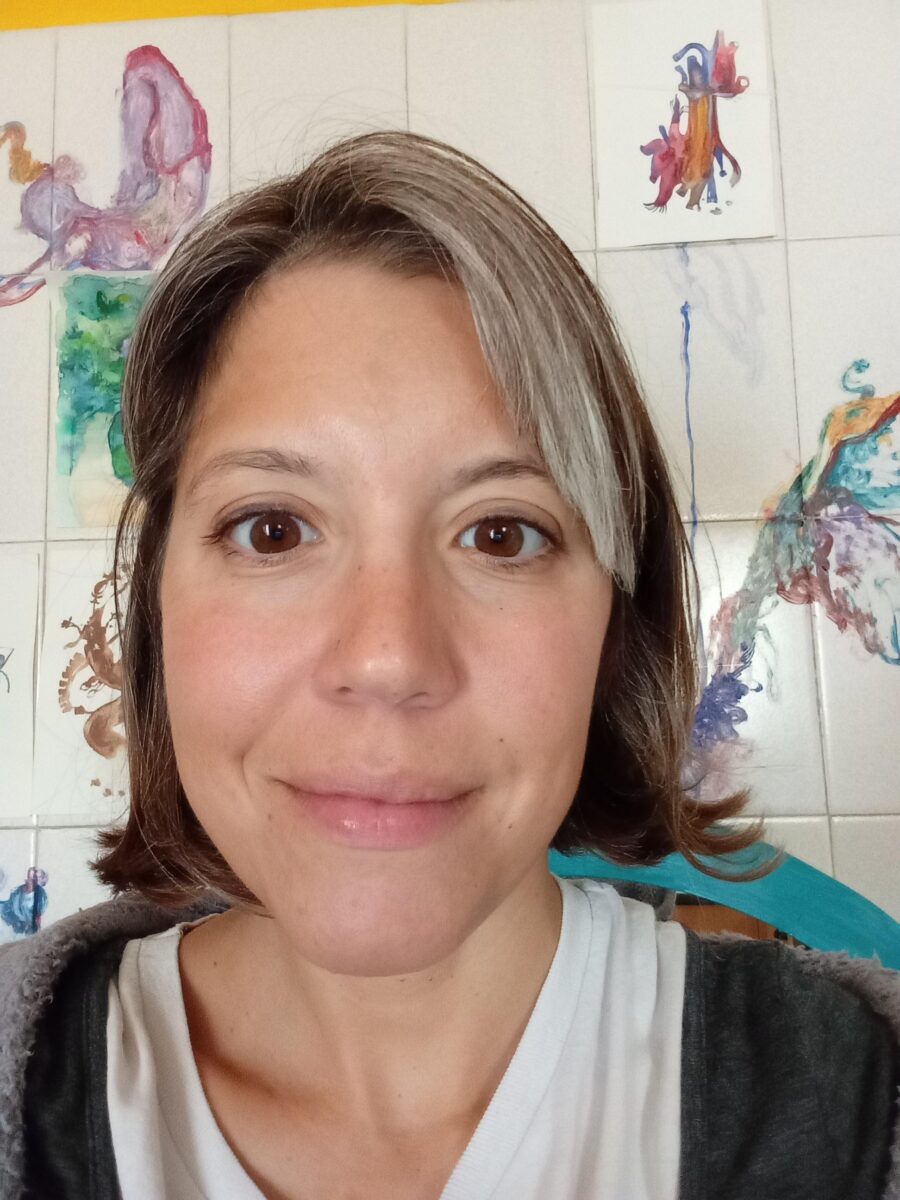
Dimitra Bouritsa

Find the stamp at the Pragmateftis Elementary School
Please contact Michalis Kyrios by calling 6974107046
Dimitra Bouritsa (1988, Greece) is a visual artist and educator. Her artistic practice draws inspiration from the female experience as a metaphor for origin, life, established patterns of human relationships, collective systems, nature, fundamental emotions, and the paths of existence. In her work, what is considered maternal serves as a means of exploring what it means to evolve alongside others. Zoomorphic motifs serve as gateways to the otherness that coexists within us, often leading us back to primal human societies, shaped by our reciprocal relationship with nature and our coexistence with the non-human realm.
In practice, the mask resembles a facade that can simultaneously reveal and conceal, erase or silence. The diary, as a medium for recording daily life as well as history or myth, is a central element of her work; a framework that gives voice to the unknown and legitimizes the imaginary. The use of color as a vehicle for creating abstract worlds, guided by emotions and influenced by behavioral conditions, is of paramount importance in her painting, even when the works vary in scale and volume depending on the physical or psychological effect they seek to evoke.
By depicting bodies and faces in constant flux, Bouritsa expresses an identity that is both collective and personal—an identity that presents womanhood and femininity as forms of empowerment and liberation. How can painting, when it functions as a gestural or performative act, reveal power relations, deconstruct hierarchical systems, or challenge oppressive behaviors? How can we use the microenvironment of the family as a means of renegotiating the stereotypical image of women, their place, and their rights in the world? How can domestic spaces be redefined so that they function as liberating rather than restrictive? And in what ways can elements inspired by nature—the flora, fauna, and non-human species that surround us—be transformed into another language for asserting autonomy and self-confidence?
These are some of the questions that emerge from Burica’s work, which is expressed through metaphysical and allegorical motifs, as well as figures inspired by folk tales and cultural traditions. The interconnection of contemporary cultures and ancient knowledge is organically integrated into her work, like a transcription of conventions that were once devised but lost to time. In her paintings, the ancient and the contemporary come together to redefine dominant paradigms and established norms.
And this is precisely where poetry enters her work. Her poems are not written merely to accompany an image; they claim a life of their own, guiding us through their own time and space. They seek to create a visual play on words, a universal universe that encompasses everything around her.